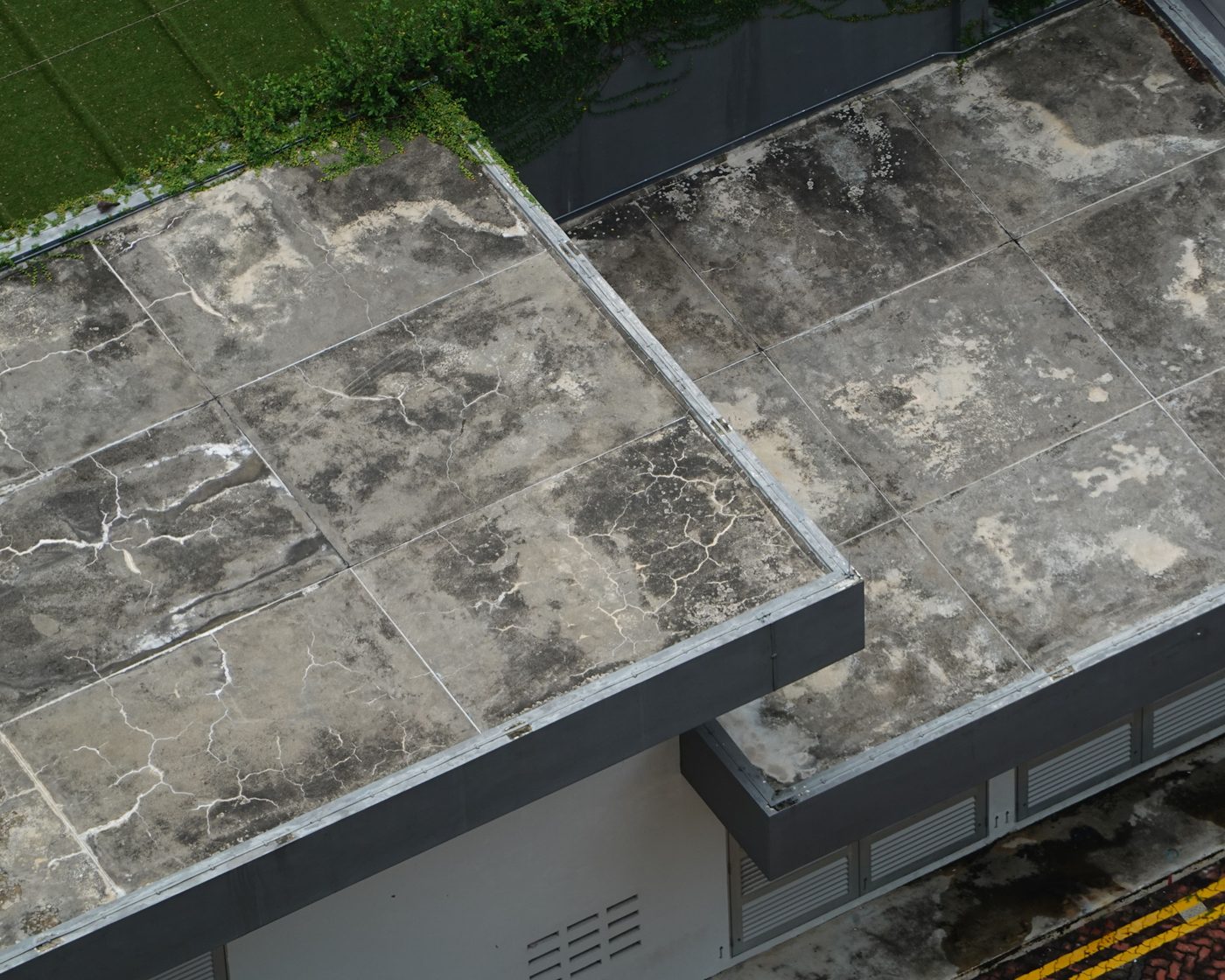
This is a checklist for the site visit. It is not a condition survey: it is the shorter list of things that, once seen, change what the rest of the diligence has to do.
Each row says what to look for and what it usually means. Where a row says stop, it means get a roofing specialist on the roof before the number in your model is treated as real.
On the surface
| Look for | What it usually means |
|---|---|
| Soft or spongy areas underfoot | Wet insulation in the build up. Stop and survey |
| Many patches, especially overlapping | The roof is being repaired rather than maintained |
| Mastic used along seams | A seam problem sealed by hand rather than reworked |
| A single freshly coated area | Recent work with no record. Ask for the invoice |
| Surface noticeably darker in patches | Trapped moisture or heat damage, both worth measuring |
| Splits that follow a straight line | Movement in the deck or a substrate joint below |
| Ballast moved or piled | Wind scour, or somebody has been working and not reinstated |
At the details
| Look for | What it usually means |
|---|---|
| Membrane pulled away from an upstand | Failed adhesion or movement. Water has a path in |
| Open or lifted edge metal joints | Wind damage or poor detailing, and staining below confirms it |
| Fixings driven through the membrane | Equipment installed without a roofing detail |
| Pipe collars split at the top | A common and cheap repair, but a sign nobody is maintaining |
| Curbs sealed with mastic at the corners | The corner detail has failed and been patched |
| Skylight flashings lifted | Water entry directly over an occupied space |
In the drainage
| Look for | What it usually means |
|---|---|
| Standing water after dry days | Falls are wrong, or the deck has deflected |
| Tide marks across a wide area | Water stands regularly, whatever the roof looks like today |
| No overflows anywhere | A blockage becomes a structural load with nowhere to go |
| Outlets packed solid | No maintenance regime, whatever the contract says |
| Staining down an external wall | A scupper or outlet has been failing for some time |
Inside the building
| Look for | What it usually means |
|---|---|
| Ceiling stains away from any detail above | Water traveling laterally in the build up. Stop and survey |
| Stains that have been painted over | A known leak, treated cosmetically |
| Rust lines on a metal deck | Long term water contact, often above a sound looking surface |
| Buckets, trays or diverters in a plant room | An active leak somebody has normalized |
| Tenant complaints in the correspondence | The record the condition report will not contain |
In the paperwork
| Look for | What it usually means |
|---|---|
| No maintenance records | The warranty conditions are probably already breached |
| Repair invoices rising year on year | The roof has entered the expensive part of its life |
| Repairs clustered on one area | A detail or design problem that patching will not end |
| A warranty that does not transfer | Cover you were counting on does not arrive with the building |
| Roof work with no permit | A question about the work, not only about the file |
| An open insurance claim | Work and evidence may both be constrained |
What to do with it
- Photograph every flag twice, wide and close. Wide to place it, close to show it.
- Mark each one on the roof plan. Several flags in one area are usually one cause.
- Separate stop from price. A stop needs a specialist; a price needs a scope.
- Ask for the invoice behind anything that looks new. Neutrally, and early.
- Write what you could not examine. The unexamined area is the one that surprises somebody later.
Want the reasoning behind these flags? Read the red flags article and what a diligence inspection covers.
Walked by Date Roof
Common questions
What counts as a red flag rather than ordinary wear?
Anything suggesting that water is already inside the build up, that the roof has been patched instead of maintained, or that somebody has worked on it without leaving a record. Ordinary wear spreads evenly across a roof, while a flag concentrates in one place.
- Wear is even across the roof; a flag is concentrated
- Water inside the build up is invisible from above and expensive below
- A patch is a repair; many patches are a strategy
- Undocumented work raises a warranty question as well as a quality one
Ordinary wear is priced into a reserve and forgotten about. A red flag changes the scope of the diligence itself, because it means the roof needs a specialist look before the number in the model can be trusted at all. The distinction matters most under time pressure, when the temptation is to treat everything as wear and move on to the next item on the list.
Does one red flag kill a deal?
Rarely. What it changes is what you need to know before committing, and usually what the roof line in the model should say. Most flags resolve into a scope and a number once somebody competent has looked at them properly.
- Most flags resolve into a scope and a number
- A flag that cannot be examined is worse than one that can
- Several flags together usually point at one underlying cause
- The deal risk is an unknown, not a cost
The useful question is never whether the roof is bad. It is whether the roof can be understood inside the time available, and what it costs to put right. A flag that answers both is a negotiation. A flag that answers neither is a reason to extend the diligence period or to walk, and saying so early is cheaper than saying it late. Flags found in week one are negotiating material; the same flags found in the final week are an emergency.
What should trigger a moisture survey?
Soft or spongy areas underfoot, a repair history concentrated in one place, interior staining with no obvious source above it, or a roof over fifteen years old with no survey anywhere on file. Any one of those is enough on its own.
- Underfoot movement is the clearest surface sign of wet insulation
- Interior staining away from a detail usually means lateral travel
- Wet insulation does not dry out and does not stay still
- A survey converts an unknown area into a measured one
A survey is priced per square foot and is cheap against the cost of discovering wet build up after closing, when it is your problem rather than a negotiating point. It also produces a plan rather than an opinion, which is what a capital plan and a price negotiation both need in order to be taken seriously. A surveyed area can be scoped, priced and argued over; an estimated one can only be disputed.
How do you tell a repair from a cover up?
By asking for the invoice. Work with a scope and a date behind it is a repair. Fresh coating over one area with no paperwork is a question, and it is a question worth asking neutrally and early rather than at the end of the process.
- Coating applied to one area only is worth asking about
- New sealant along an old seam hides the seam rather than fixing it
- Paint on edge metal can hide joints that have opened
- A clean roof before a sale is normal; a newly coated one is not
Most of the time the answer is ordinary and documented, and asking costs nothing. Where no document exists, the finding is not that somebody hid something. It is that the work is unverified, and an unverified repair has to be modeled as no repair at all, which is usually the more expensive of the two assumptions and occasionally the one that changes the deal.
What is the single most expensive thing to miss?
Wet insulation across a large area, because the remedy is a tear off rather than a repair and the cost moves by an order of magnitude. A roof can look fair from above and still need stripping down to the deck.
- A patch repairs a membrane; it does not dry a build up
- Wet insulation loses thermal value as well as structural integrity
- The deck beneath can corrode or rot while the surface looks sound
- Partial replacement rarely stops at the area first identified
This is why surface condition alone is never the answer to the question the model is asking. The only way to know inside a diligence window is to survey rather than to estimate, and the survey is worth commissioning on any older roof where the paperwork does not already contain one with a date you trust. The cost of the survey is almost always smaller than the range of the estimate it replaces.